"A person cooking is a person giving: Even the simplest food is a gift."

Laurie Colwin
Showing posts with label Opinion. Show all posts

Sunday, October 16, 2011

The World Food Day blog


On World Food Day, I don’t want to write a blog as if for my teenage students.  We are all adults, and we all know that the causes of hunger are complex and myriad, and range from drought, to war, to the use of arable land to plant bio-fuel crops.  We adults we know that as worthy, and generationally effective, as sponsoring a child or loaning money to an entrepreneur through a micro loan agency such as Kiva is, it doesn’t solve a cataclysmic “issue” that amounts to 1 billion people going hungry in the world.

But if you’re an adult it also means certain things.  Like if you have made it to this age, it means that you know something about trying, trying, and trying again.  You probably have an inkling about what’s important by now.  You may have had children, and know what it’s like to be gripped by the urge to protect and look after them; it’s not too big a stretch to imagine how a parent who cannot look after her or his child might feel.  You have probably seen changes that when you were a kid were certain couldn’t happen without bloodshed: the demolition of the Berlin wall, the dismantling of apartheid. 

I’m not big on guilt.  Guilt is, to me, the ultimate self-indulgence.  It provides a buzz:  “Ooh I feel so bad about this you can’t believe how bad I feel I’m just totally cut up look I’ve got tears in my eyes and I’m so earnest I’ll even post about it on my Facebook status so that proves I’m human right?”  Being human, however, requires more than feeling, it requires action, and that leads me to the thing I am big on.

Responsibility.

You can stay stuck in guilt forever, but you can’t stay stuck when you’re in responsibility.  Responsibility means owning.  Means doing.  Lots of doing.  So much doing that you won’t have either the time or inclination to “click ‘like’ if you agree”.

That’s why I’m not going to waste any time trying to push your guilt buttons.  There are people in your life better at it than I.  Instead, I’m thinking that if you are reading this blog, there’s also a good chance that you are used to feeding people, or that you understand there’s something primal about providing and nourishing, even beyond the boundaries of your nearest and dearest (else why the existence of so many food blogs that reach out to all corners of the globe?).  This is something we all GET.  We may well be enjoying this fillet steak, or indeed this piece of bread, but we don’t like the thought of others not having the same.  Given your druthers, you’d shout, “Fillet steak and bread for all!”

Well, maybe one day. 

In the meantime, let me introduce you to a people that are rather well known for being practical and pragmatic:  the British.

Oxfam UK has a brilliant campaign called 4-a-Week going.  This simple-as idea is designed to make a tangible difference in the lives of people living in poverty and just involves doing four easy things each week:

1. Buy one more Fairtrade product
2. Buy one more food product from a developing country
3. Throw one less item of food away
4. Eat one less portion of meat or dairy


If you don’t know what Fairtrade is by now, you should.  It’s all about a better deal for the farmers and workers who work to bring you your chocolate or breakfast cuppa, and every purchase makes a difference.  Look for the distinctive Fairtrade logo wherever you shop, and if you can’t see any products where you shop, demand them.  (Don’t kid yourself, however, that companies who advertise something akin to Fairtrade without the name and logo themselves are actually doing anything.  Your morning coffee from Starbuck’s may promise to be “ethical”, but Starbuck’s is, in fact, self-regulating about what constitutes “ethical” and “fair trade”.  Starbuck’s stopped paying a premium price for their coffee a long time ago, and they conduct their own inspections of coffee farms.)


Yes, of course it’s good to buy local.  And yes, of course food miles are important.  But let’s not be coy here and pretend everything we eat is locally sourced or foraged.  Where is your olive oil from?  How about that Arborio rice you make your risotto with?  There is room in your shopping basked for a handful of dates from the Middle East, or some lentils from India.  Don’t know what classifies as a “developing country”?  No worries, I have a big fat list for you right here.  


Throwing one less item of food away is a subject of a whole nother blog because there are so many ways to go about this.  The simplest way is to buy only what you know you’ll use.  And if you don’t, use it.  Those potatoes will turn into a great frittata, and you know curry tastes better the next day.  Use the freezer.  Get organised.  Have a big cook-off – perhaps on Recycling Fridays – of the stuff in the ‘fridge before you go shopping.  The Love Food Hate Waste site has lots of ideas on how to avoid waste.


Eating one less portion of meat or dairy makes an impact in two ways.  The first is environmental, since all that livestock must have an effect.  The other one is a matter of resource allocation.  The production of beef, for example, requires 4.8 lb./2kg of grain fed to cattle to produce just 1 lb./450g. of beef.  That is grain that could be used for humans.  A 10-acre farm can support as many as 60 people by growing soybeans, but only two people by producing cattle.  Now – I love me some beef, but I love me some grain, too.  Give me a plate of pasta pesto or a bourghul pilaf dotted with chickpeas and roasted peppers and I won’t even notice there wasn’t meat or dairy.  Neither will you.

Come on.  Four things a week is easy.  Let’s do this.  Because we're grownups, and we know how to get things done.

Tuesday, October 4, 2011

The "F" word

In a world that produces enough food for each one of its inhabitants to eat 2,700 calories a day, famine is unacceptable.  


This isn't about guilt, and it isn't about donating money.  It's about us knowing better, and being loud enough to say so.


 Watch the vid, sign the petition.  FFS.

Thursday, August 26, 2010

Overkill

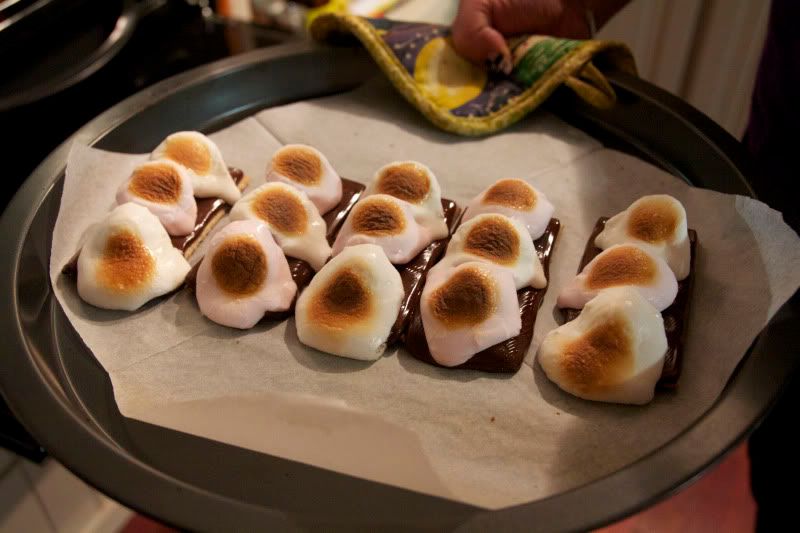
I have a weakness for Smores (more on this later) and a few days ago made mega indoor Smores, each one with a rectangular wholewheat cracker, a whole 25g serve of Aldi’s Moser Roth dark chocolate, which is a lot, and three marshmallows.

My older son pulled up to the kitchen just as I was getting them out of the grill, and looked down at the tray of oozing sweetness I was holding.

“Mum, Men at Work just rang.  They want ‘Overkill’ back.”


Monday, August 2, 2010

The Ministry of Marketing

I didn't watch the TV show.  It was enough to see Jamie Oliver seated at table underneath big-boned, healthy letters announcing “Ministry of Food” everywhere from bookshops to tram stops.  And beneath his generous helping of roast chicken and veg, this claim:  “Anyone can learn to cook in 24 hours”.  When I first saw the book, I was expecting ellipses after this extraordinary statement, or maybe a “P.T.O.”, and we’d find the rest of the sentence – the proviso – when we opened the book.  But there are no ellipses, there is no proviso.  Anyone can learn to cook in 24 hours, full stop.  Well, actually, there is no full stop, but it’s implied.  And it’s that implied full stop that will make this book a success or failure.

First, let’s define success.  Of course the cookbook will be a publishing success and keep Jamie in Lambrettas until he’s older than Paul Weller, but will it succeed where Jamie says it will?  Because this isn’t yet another cookbook, he says.  Oh, no.  It’s a Movement.  And he needs our help, he says.  Show someone how to cook a recipe, he says, and let them pay it forward by teaching another someone how to cook a recipe.  Let those someones go forth, and so on, and soon there will be a Wembley Stadium-full of people who can cook.  (But presumably not cooking there.  Although wouldn’t all those mortars and pestles pounding away give screaming hordes of Beatlemaniacs a run for their money?)  Before you know it, all of Britain will be well fed and happy!  And look:  there’s even a pledge in the book for you to sign.  But before you think this is all a bit silly, let it be known that the idea for the Movement isn’t new, he says:  it’s what women representatives from the Ministry of Food were doing post-WWII, when after years of rationing the people of Britain had forgotten what food was and how to cook it.  It’s also “a modern-day version of the way people used to pass recipes down through generations when they weren’t all at work”.

So will it work?  No.  Why?  Because Jamie’s Movement needs a stool.

It was from my stool, watching Mamá, that I learned how to cook.  Other cooks came along later who augmented her teaching with advanced technique and wonderful recipes, but they didn’t teach me how to cook.  Because as any good cook will tell you, learning to cook and learning to reproduce recipes are two completely different things.  From my ma I learned everything.  She taught me how dishes begin, and end.  How something should smell when it’s properly seasoned.  How it should feel (and I can therefore guarantee that any exact recipe for potato gnocchi is wrong).  How to look:  watch how the mayonnaise comes together, how the colour of homemade jam is different to the stuff you buy in jars.

As I looked, I also learnt to recognise the attributes of the good cook.  The alchemy that turns plain rice into golden fritters perfumed with parsley and parmesan a couple of days later.  The genius of the dish that can’t ever be repeated because it pulls together whatever happens to be in the fridge that day.  The fearlessness of improvisation.  The husbandry and thrift that allows you to use a glut of anything without the family turning into a Greek chorus of, “Oh, no, not zucchini again.”  Loaves and fishes-type miracles.  Confidence instead of cookbooks.  Assurance in dishing something out knowing that it won’t be measured against some restaurant standard but simply received with thanks.  And the wisdom of knowing when to order take-away, because a family would rather have fish and chips with a relaxed and happy cook than a banquet from some gastronomic martyr.  She is the reason why I can cook, and others like her are the reason why others can cook.  But the race of people who can cook could be rendered extinct by the race of people who can reproduce recipes.  And why not?  Learning to cook isn’t as sexy as watching Nigella fellate her fingers, or as funky as racing slot cars at Jamie’s while the cassoulet bakes, or as illicit as sniggering at Gordon’s naughty swearing.  It can be boring and repetitive, and the cook you’re watching isn’t on show for the camera, so what you see, alas, is what you get.

Is the reason we (or rather, the Brits) don’t cook that no one has had time to show us a recipe?  Because I don’t know what nobility Jamie descends from, but there hasn’t really been a time when the majority of the peoples of the world weren’t all at work.  Any anthropologist will tell you that traditionally, most people everywhere have eaten very simply on a day-to-day basis, just because of the aforementioned work, and saved the elaborate prep, cooking, and presentation for food served on special occasions.  But let’s say he’s right and ignore pesky anthropologists and that nonsense of man having to earn his bread by the sweat of his brow and a woman’s work never being done.  Let’s take it to the authorities:  The Women’s Weekly.  I have here a copy of The Women’s Weekly Busy Woman’s Cookbook, published in 1972.  So let’s assume that women – the traditional home cooks – have only been busy since 1972.  That’s two generations ago.  Has no one bothered passing on a recipe since?  What does the wall of cookbooks in any bookshop, the endless reel of cooking shows on the telly, and the millions of recipes in disposable media and Internet tell you?  Yeah, we’re busy.  But how is one extra recipe from either a Movement or a mate supposed to make a difference?  After Jamie has taught John and Jane how to cook their one dish, who is going to teach them what to do with the stuff they buy from the produce section rather than the frozen meals cabinet? 

The creation of any industry requires us to accept one of a few key messages:  “You can’t do this”, “You don’t have time to do this”, “You shouldn’t do this”, “You need help to do this”, and most insidious of all, “Even if you can find the time to do this without help, it won’t be good enough.”  (For the beauty and weight loss industries, substitute the verb “do” with “be” and you’ll be well on your way to self loathing.)  This is, without a doubt, the convenience food manufacturers, but it’s also every superstar chef who’s made millions out of demonstrating recipes – often unattainable, tyrannical ones, in anything from execution to cost to setting – rather than teaching anyone how to cook.  It’s a way of ensuring repeat custom, see.  Because a person who can actually cook is the superstar chef’s worst nightmare:  independent and self-sufficient.  So I’m sorry, Jamie, but you can’t ever be the solution when you’re actually part of the problem.

The solution – boring and mundane as it is – is found, yet again, in us.  A little less spectating, and a little more learning.  A little less buying, a little more growing.  A little less stressing, a little more enjoyment.  A little less opining, a little more gratitude.  A little less following, a little more experimenting.  And lot more time spent together.  But I wouldn’t hang around waiting for any great leader for this particular movement.  After all, no one ever made any money from telling people to put down the cookbook or turn off the telly and go hang out in the kitchen.